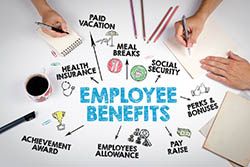
s year end approaches, businesses have plenty of tax and payroll tasks competing for attention. One easy-to-overlook area is employee and owner benefits. Identifying taxable benefits before the final payroll runs of 2026 can help prevent reporting errors, payroll tax problems and unexpected Form W-2 adjustments.
Take stock of fringe benefits
Many fringe benefits are excluded from employees' taxable income, yet employers generally may still deduct their cost as a business expense. Benefits that don't qualify for an exclusion usually must be included in employees' taxable compensation.
Common examples of benefits that may be excluded from taxable wages include employer-provided health insurance, dependent care assistance, group-term life insurance, educational assistance and certain transportation benefits (but the employer can't deduct them), subject to various limits.
Taxable fringe benefits may include personal use of a company vehicle, many entertainment and sporting event tickets, gift cards and other cash-equivalent benefits. Generally, the taxable amount is the benefit's fair market value, less any amount paid by the employee or excludable by law. Special valuation rules may apply.
Know what's new
The One Big Beautiful Bill Act (OBBBA), enacted in July 2025, made several changes affecting benefits, including dependent care and educational assistance.
For 2026, the maximum exclusion for employer-provided dependent care assistance increased to $7,500 ($3,750 for married taxpayers filing separately).
The OBBBA also made qualifying student loan payments permanently eligible for the educational assistance exclusion and added inflation adjustments after 2026. For 2026, employers generally can provide up to $5,250 in tax-free educational assistance, including qualifying student loan payments.
Don't overlook special owner rules
Fringe-benefit rules can differ for business owners, depending on the entity type and benefit involved. For instance, one particularly important year-end payroll issue applies to S corporation shareholder-employees who own more than 2% of the company. Health and accident insurance premiums paid or reimbursed by the S corporation generally must be included in the shareholder-employee's Form W-2 wages for federal income tax purposes.
Provided certain requirements are met, the premiums generally aren't subject to Social Security, Medicare or federal unemployment taxes. Proper reporting can also affect the shareholder's ability to claim the self-employed health insurance deduction.
Act before year end
Don't wait until Forms W-2 are prepared. Failing to account for taxable benefits properly can lead to insufficient federal income and payroll tax withholding, underpaid employer payroll taxes, penalties and incorrect wage reporting. Contact us to review employee and owner benefits and determine the proper tax treatment before year end.